July 22, 2026
The Wrights Won Their Aviation Patent War by 1914. In World War I, U.S. Pilots Flew European Planes.
Subscribe
They patented the control system that made flight possible, sued every rival who built an airplane, and won in court. The prize was an American aircraft industry so frozen that the United States entered World War I with no combat planes of its own and had to force a patent pool under threat of confiscating the patents.
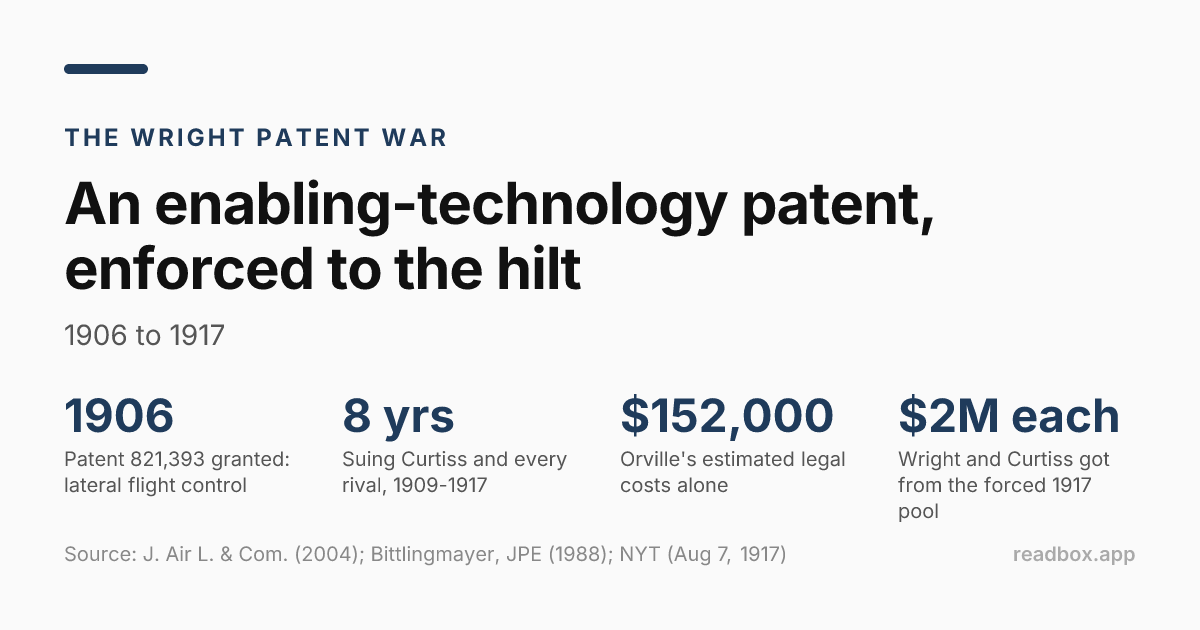
On May 22, 1906, the U.S. Patent Office granted Orville and Wilbur Wright patent number 821,393. It did not cover the airplane. It covered the control system, the method of warping the wings to bank and turn, which they had worked out on the 1902 glider at Kitty Hawk. But they drafted it broadly: any device that varied the wings' lateral edges in opposite directions fell within it. That included ailerons, the hinged flaps every other designer was already reaching for. (centennialofflight.net; ERAU JAAER)
The first serious challenger was Glenn Curtiss, a motorcycle engine builder whom Alexander Graham Bell had recruited into his Aerial Experiment Association in 1907. On July 4, 1908, Curtiss flew the June Bug 5,360 feet, won the Scientific American trophy, and Orville wrote to warn him not to use the Wright control system "in a commercial way." When Curtiss sold a plane anyway, the Wrights sued in 1909. (centennialofflight.net)
What followed was eight years of litigation. Judge John R. Hazel granted a preliminary injunction in January 1910; the appeals courts affirmed the Wrights as "pioneers" and by 1913-1914 ordered Curtiss to stop building aileron-equipped planes. Orville reportedly said the ruling would "give us an absolute monopoly." He was mistaken about what a monopoly was worth. (SMU J. Air L. & Com.)
The mechanism is the part worth pausing on. A patent on an incremental improvement excludes a competitor. A patent on the foundational enabling technology of an entire industry excludes the industry. The Wrights' control claim was basic enough that no controllable airplane could be built without touching it, so enforcing it did not pick a rival to beat, it switched off the market. Their old mentor Octave Chanute wrote to Wilbur that his "usually sound judgment has been warped by the desire for great wealth." Wilbur died of typhoid fever on May 30, 1912, age 45, and the family blamed the strain of the litigation. (ERAU JAAER; NPS)
Curtiss found a way to keep the war alive. Henry Ford, who had just beaten George Selden's automobile patent with the lawyer W. Benton Crisp, sent Curtiss to the same man. Crisp had Curtiss reconfigure his controls around the Smithsonian's Langley aerodrome, forcing the Wrights to relitigate from scratch. The case ground on. By 1915 every airplane flew on ailerons, not wing-warping; Orville sold his stake in October 1915 and retired. (centennialofflight.net; Bittlingmayer, JPE 1988)
Meanwhile Europe, where the Wright patents were weaker and expired sooner, built the aircraft industry the Wrights were suing out of existence at home. By 1913 France budgeted about $7.4 million for military aviation; the United States spent roughly $125,000. When America entered the war on April 6, 1917, it produced no combat aircraft of its own design for the front; every fighter its pilots flew in American service was of European, principally French, design. (NPS)
The freeze became intolerable, and Washington broke it by force. The Wright-Martin successor company was demanding up to $1,000 per airplane and threatening to sue any manufacturer that built one. In January 1917 the secretaries of war and the navy called for peace; after the declaration of war, the National Advisory Committee for Aeronautics, pushed by Assistant Secretary of the Navy Franklin Roosevelt, proposed a cross-licensing pool. Wright-Martin resisted until Congress prepared legislation to condemn the patents outright. (Bittlingmayer, JPE 1988)
The Manufacturers Aircraft Association, formed July 24, 1917, cross-licensed some 130 patents. The blanket fee fell to about $200 per airplane, roughly one percent, down from the $1,000 Wright-Martin had wanted; the New York Times reported the Wright and Curtiss interests would each ultimately receive about $2,000,000. All litigation stopped. The pool was meant to last only for the war, and when the war ended no one renewed it. It worked well enough that the arrangement outlived the war by decades. (NYT, Aug 7, 1917; BHC)
Not every historian agrees the patent war single-handedly stalled American aviation; the industry was young and capital-starved either way. But the shape of the failure is clear: the Wrights won every case they needed to win and still captured a market that did not exist. (Wikipedia) The same compulsory-pool instinct that ended this deadlock rhymes with an earlier American first, the sewing machine patent pool of 1856, which the industry formed voluntarily to escape a litigation tax. Here the government had to impose it.
The takeaway. A patent on the foundational layer of a new industry is not a moat, it is a kill switch on your own market. The question is never whether you can exclude, it is whether exclusion grows a market you can capture or freezes one you cannot. License the enabling technology broadly and early, let the installed base and the complement makers multiply, and collect a small royalty on a large industry rather than a monopoly rent on none. The Wrights could have been the toll booth on American flight. Instead they became the reason someone had to tear the booth down. And the one force that breaks a patent thicket faster than the market is a war: the moment the gridlock costs the government more than the patent does, the patent stops being property and becomes a problem to be confiscated.
That’s the reading for this issue.
- Betamax Owned 100% of the VCR Market in 1975. By 1988 It Had 12%. Jul 21
- A&P Sold $1 Billion of Groceries From 16,000 Stores. The Government Convicted It for Pricing Too Low. Jul 20
- AT&T Dumped 7 Local Monopolies in 1984 to Keep the Profitable Half. One Bought It Back for $16 Billion and Took Its Name. Jul 19
- A Singer Cost $100 When a Family Made $500. His Lawyer Invented Installments, and Buyers Preferred $100 in $5-a-Month Payments to $50 Cash. Jul 18
Want the next one?
Every new Business History Daily issue by email. One tap to unsubscribe.