July 21, 2026
Betamax Owned 100% of the VCR Market in 1975. By 1988 It Had 12%.
Subscribe
Sony built the first home VCR and tried to keep the format to itself, betting a sharper picture and premium margins would set the standard. JVC licensed VHS to anyone who would build it, the hardware got cheap, the rental stores standardized on it, and the installed base became the moat Sony never had.
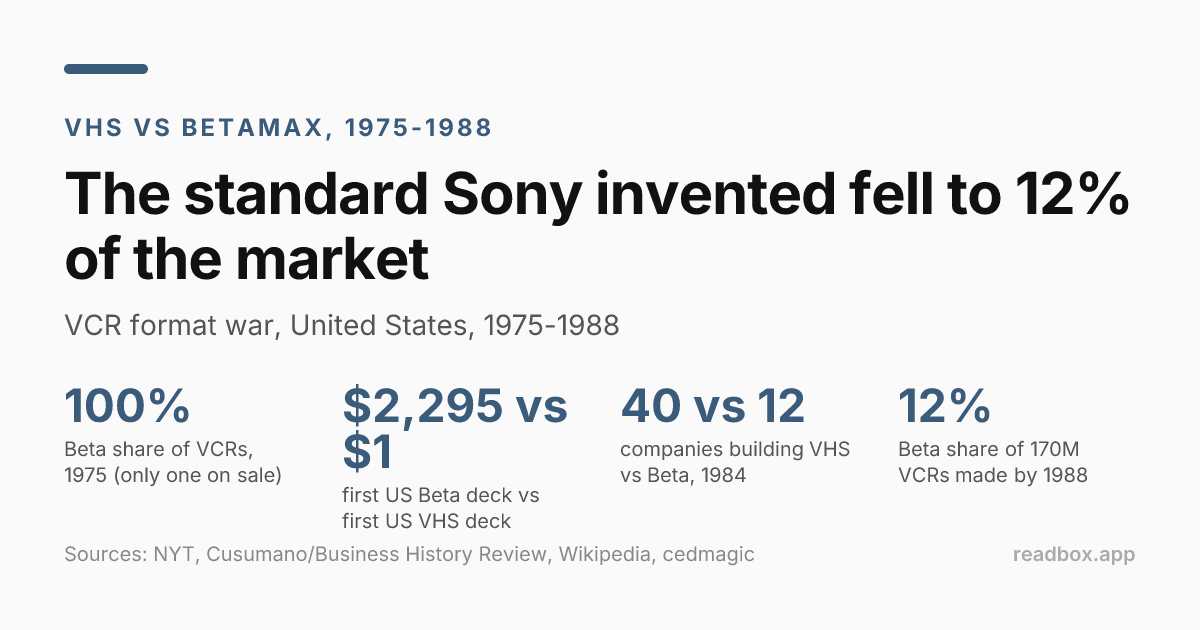
On May 10, 1975, Sony's SL-6300 Betamax went on sale in Japan, and that November the United States got it as the LV-1901, a 19-inch Trinitron television bolted to a recorder, priced at about $2,295. Sony marketed the machine as a "time-shift" device: record a show, watch it later. The tapes ran one hour and cost $15.95. It was the first practical home VCR, and Sony had the category to itself for a year; by the time a rival appeared, roughly 100,000 Betamax decks had sold.
Sony's plan was never just to sell decks. It was to own the standard. In December 1974 it had shown Betamax to Matsushita, JVC, and RCA, expecting them to fall in behind it, one account summing up Sony's posture as "we completed this one, why don't you simply follow us" (Backus & Cabral, NYU Stern). They did not. When Hitachi asked to license the format in July 1975, Sony said the machine "was not yet perfected" and turned it down (Cusumano, Mylonadis & Rosenbloom, Business History Review 1992). Sony had compromised on its earlier U-Matic format and regretted it; this time it would not dilute the design. Years later Sony's president Akio Morita admitted the mistake: "We didn't put enough effort into making a family. The other side, coming later, made a family" (NYU Stern).
On September 9, 1976, JVC answered with VHS, the HR-3300, and a two-hour tape. Its strategy was the mirror image of Sony's: license the format to anyone, and design it to be cheap to build. By the end of 1976 Hitachi, Mitsubishi, and Sharp had joined Matsushita in the VHS camp. In the United States, RCA signed on in March 1977 after demanding a longer recording time; Matsushita built it, and RCA's VBT200, announced that August and in stores by October, sold at about $1,000 against roughly $1,300 for a Betamax, recording four hours to Beta's two. Konosuke Matsushita, choosing VHS over Beta, said the JVC machine "has fewer components... we must choose the product that can be manufactured more cheaply... the only way to overcome the disadvantage of being a latecomer" (ANSI). By 1984, forty companies were building VHS decks; twelve built Beta.
The two-hour tape, then four, six, and eight, was the wedge: people wanted to record a whole movie or a football game, not an hour of one. Sony matched two hours in 1977, but only by slowing the tape and erasing the picture-quality edge it had been selling. The lock-in was network effects. As VHS decks multiplied, video rental stores stocked VHS titles; consumers bought VHS to get the selection; more VHS titles appeared. The VCR's real use shifted from Sony's "time-shift" pitch to renting prerecorded movies, a market Sony had not modeled. By 1988 a Beta owner "began to face a serious shortage of pre-recorded videotapes," and most rental shops carried few or none. An econometric study later estimated that if Sony had pushed aggressively at the start, Beta might have won by 1985; instead it was gone as a mass market by 1989 (Ohashi, JEMS 2003). It was not technological destiny. It was licensing speed.
VHS took 60% of North America by 1980, Beta's US share fell to 25% by 1981, and VHS hit 90% of the US market by 1987. In January 1988 Sony conceded and announced it would build VHS decks; of the 170 million VCRs made worldwide since 1975, only about 20 million, or 12%, were Beta. Sony kept making Betamax recorders until 2002 and blank tapes until 2016.
The same machine drew a second assault, from the studios. In November 1976 Universal and Disney sued Sony to ban the VCR, arguing that home taping of free television was copyright theft; the MPAA's Jack Valenti told Congress in 1982 that "the VCR is to the American film producer and the American public as the Boston strangler is to the woman home alone." The Supreme Court disagreed, 5-4, in January 1984: home time-shifting was fair use, and the Betamax was "capable of substantial noninfringing uses" (Sony v. Universal, 464 U.S. 417). The studios that tried to kill the VCR then made their largest profits from it. Home video revenue passed the box office around 1986, about $4.38 billion to $3.78 billion (TechCrunch); by 1988 roughly 35% of the major studios' feature-film revenue came from home video, up from 3% in 1980 (NYT, 1989). Universal and Disney had opened their own home-video arms in 1981.
In a two-sided market, hardware on one side and content on the other, the binding constraint is the installed base, not the deck. Sony optimized for recorder margins and control of the standard; the studios optimized for banning the copying; JVC optimized for the size of the ecosystem, and the ecosystem priced the standard for it. When the value lives in complements (tapes to rent, apps on a phone, games on a console), the winning move is to license the platform cheaply and widely so the complement market grows the installed base for you. A superior product you keep to yourself loses to a good-enough product everyone builds. The open-architecture lesson is the same one IBM handed to Microsoft a few years earlier: give away the layer the market is going to route value through, and own the chokepoint the complement market depends on.
That’s the reading for this issue.
- The Wrights Won Their Aviation Patent War by 1914. In World War I, U.S. Pilots Flew European Planes. Jul 22
- A&P Sold $1 Billion of Groceries From 16,000 Stores. The Government Convicted It for Pricing Too Low. Jul 20
- AT&T Dumped 7 Local Monopolies in 1984 to Keep the Profitable Half. One Bought It Back for $16 Billion and Took Its Name. Jul 19
- A Singer Cost $100 When a Family Made $500. His Lawyer Invented Installments, and Buyers Preferred $100 in $5-a-Month Payments to $50 Cash. Jul 18
Want the next one?
Every new Business History Daily issue by email. One tap to unsubscribe.