July 15, 2026
The Freight Contract That Paid Rockefeller on His Rivals' Oil, and Never Shipped a Barrel
Subscribe
A secret 1872 deal gave Standard Oil a rebate on its own shipments and a "drawback" on every barrel a competitor shipped. Pennsylvania's oil producers shut it down before it moved a barrel. Rockefeller had already used the threat to absorb 22 of Cleveland's 26 refiners.
In June 1870 John D. Rockefeller folded his Cleveland refineries into the Standard Oil Company. The country had 40,000 barrels of daily refining capacity and a market for only 16,000; oil was a glut, and the glut's refiners were bankrupting each other on price. Rockefeller's edge was never going to be the oil. It was going to be the railroad that carried it.
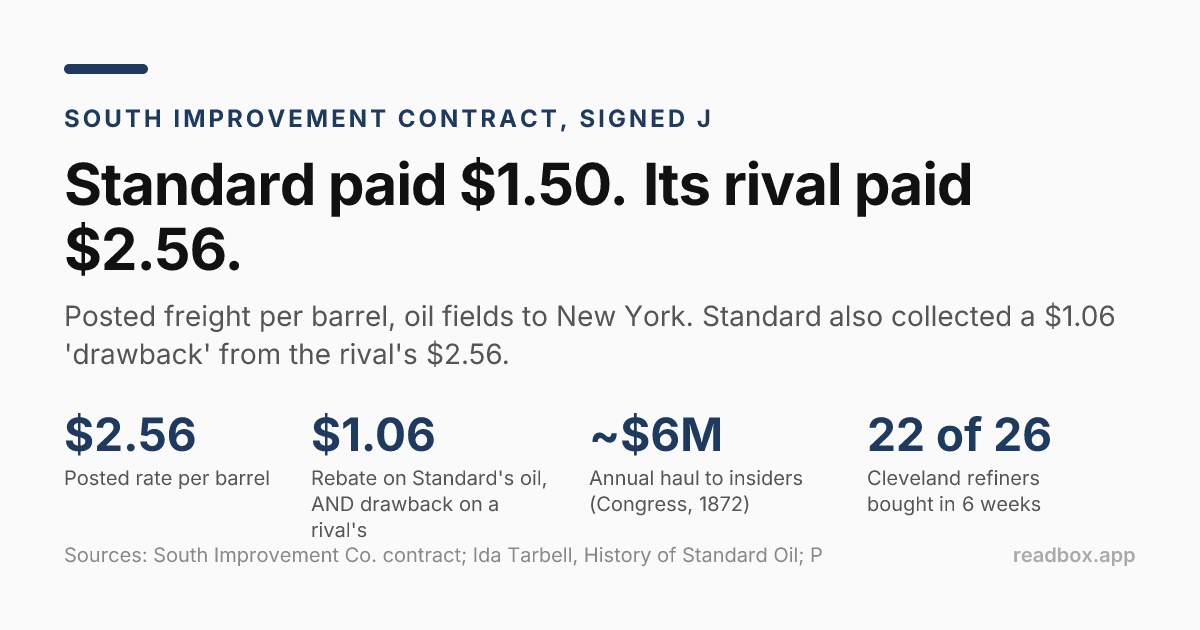
What a barrel of kerosene cost to ship from the fields to New York mattered more than what it cost to refine, because three trunk lines ran parallel and fought a rate war that left all of them thin. In the fall of 1871 the Pennsylvania Railroad's president, Tom Scott, chartered a shell company, the South Improvement Company, and on January 18, 1872 it signed a secret contract with the roads. The terms worked on both sides of Standard's shipments. Standard got a "rebate," a discount, on its own freight. And on every barrel an outside refiner shipped, the railroads paid Standard a "drawback" of the same size. On the route from the oil fields to New York the posted freight rate was $2.56 a barrel; Standard got $1.06 back on its own oil and collected $1.06 out of a rival's $2.56. A rival paid $2.56 while Standard's effective cost was about $1.50, and Standard pocketed the difference on the rival's barrel too. A Congressional committee figured the scheme would hand the insiders roughly $6 million a year on the carrying trade alone.
The rebate is the part you can almost defend. Standard shipped sixty carloads a day, enough to run a solid oil train out of Cleveland every morning, which cut a freight car's round trip to New York from thirty days to ten and the road's investment in railcars to about a third. A big, steady shipper genuinely cost less to haul, and Rockefeller's defense was the straightforward volume-discount one: "Who is entitled to better rebates from a railroad, those who give it for transportation 5,000 barrels a day, or those who give 500, or 50?"
The drawback is the part you cannot. Standard was not being paid for a service it performed. It was being paid for its rivals' existence, by the very railroads carrying them. The drawback also glued the railroad cartel together. Without it, any one line would have quietly cut a secret deal with an independent, because an independent paying $2.56 was more profitable to carry than Standard paying $1.50. Paying Standard a slice of every independent's freight erased that temptation, so the roads stopped competing for independents at all. The rivals were taxed, and the tax locked the tax collector in.
That was a flywheel. Lower cost and a rival-tax produced the margin to buy rivals, and buying rivals produced more volume, which produced bigger rebates. Word of the contract leaked in February 1872, and the oil-field producers, among them a teenage Ida Tarbell's father, called it conspiracy and boycotted the roads. By March 25 the railroads had torn the contract up and signed a pledge of equal rates, with no rebates or drawbacks to anyone. Pennsylvania voided the shell company's charter on April 2. The South Improvement Company never shipped a barrel.
It did not need to. In the six weeks the scheme was public, Rockefeller had used the threat of it to buy 22 of Cleveland's 26 refiners, roughly 85 percent of the city's capacity, and he paid them in Standard Oil stock. Within days of the roads swearing off rebates, Standard had a fresh secret one, 25 cents below the new "equal" rate. By 1877 the drawbacks were back too, routed through a pipeline subsidiary at 20 to 35 cents on every barrel of crude a rival shipped. The producers' boycott had beaten a contract. It had not beaten the structure, because the railroads wanted Standard's volume more than they wanted the producers' goodwill.
What finally broke the flywheel was not a competitor but a rule. The Interstate Commerce Act made secret rebates illegal in 1887, and in 1911 the Supreme Court dissolved Standard Oil under the Sherman Act, on a case built largely from the documents Ida Tarbell pulled out for her nineteen-part McClure's series from 1902, in which a Standard executive, Henry Rogers, had candidly explained to her how the drawbacks worked. Rockefeller recalled, in his memoirs, a Boston merchant's verdict on the whole arrangement:
"I am opposed on principle to the whole system of rebates and drawbacks, unless I am in it."
The takeaway is about where the chokepoint sits. In a glutted market the scarce thing is not the product but the pipe everyone must move through, here the railroads. Rockefeller did not try to own the oil. He made himself the roads' best and most indispensable customer, then let them price his rivals out for him and pay him for the favor. The rebate was a discount. The drawback was a tax on competitors, collected by a third party that had been made dependent on your volume. And the reason a rival boycott could not fix it is the part worth remembering: the owner of the chokepoint will not surrender its best customer willingly. Only a ban on the secret terms, or a rival route the chokepoint cannot control, breaks a flywheel that runs on someone else's dependence.
Want the next one?
Every new Business History Daily issue by email. One tap to unsubscribe.