July 29, 2026
Penn Central Merged Two Rivals Into the 6th-Largest US Company. 871 Days Later, the Largest Bankruptcy America Had Ever Seen.
Subscribe
Two rival railroads merged to save themselves, kept incompatible computer systems and executives who despised each other, and papered over a half-billion-dollar cash drain with borrowed dividends and accounting that turned a $145 million loss into $2.8 million. The integration was the whole point of the deal, and it never happened.
On February 1, 1968, the Pennsylvania Railroad absorbed its arch-rival, the New York Central, and renamed itself Penn Central. The two roads ran nearly 21,000 miles of track between them and had long ago agreed not to undercut each other's monopoly profits. By the 1960s trucks on free new highways and passengers on jets were eating them alive, so both told the Interstate Commerce Commission that merging was the only alternative to failure. Stockholders agreed in May 1962, then waited six years for regulators, during which the integration plan went stale.
The merger's entire value lived in combining two duplicate networks into one. It never happened. The two railroads kept incompatible computer systems that could not exchange freight-car data, so clerks regularly lost track of trains. Thousands of cars vanished into clogged yards; shipments sat for weeks and food and beer spoiled in the boxcars. The executives were no more compatible than the computers. Chairman Stuart Saunders, a Pennsylvania Railroad lawyer-politician, and President Alfred Perlman, the New York Central's operating wizard, "scarcely spoke to one another," as Joseph Daughen and Peter Binzen put it; Saunders allegedly called Perlman "the worst enemy I've ever had in my life." The Pennsylvania side's "red team" took the top jobs, and the modern-minded Central managers quit in wholesale lots.
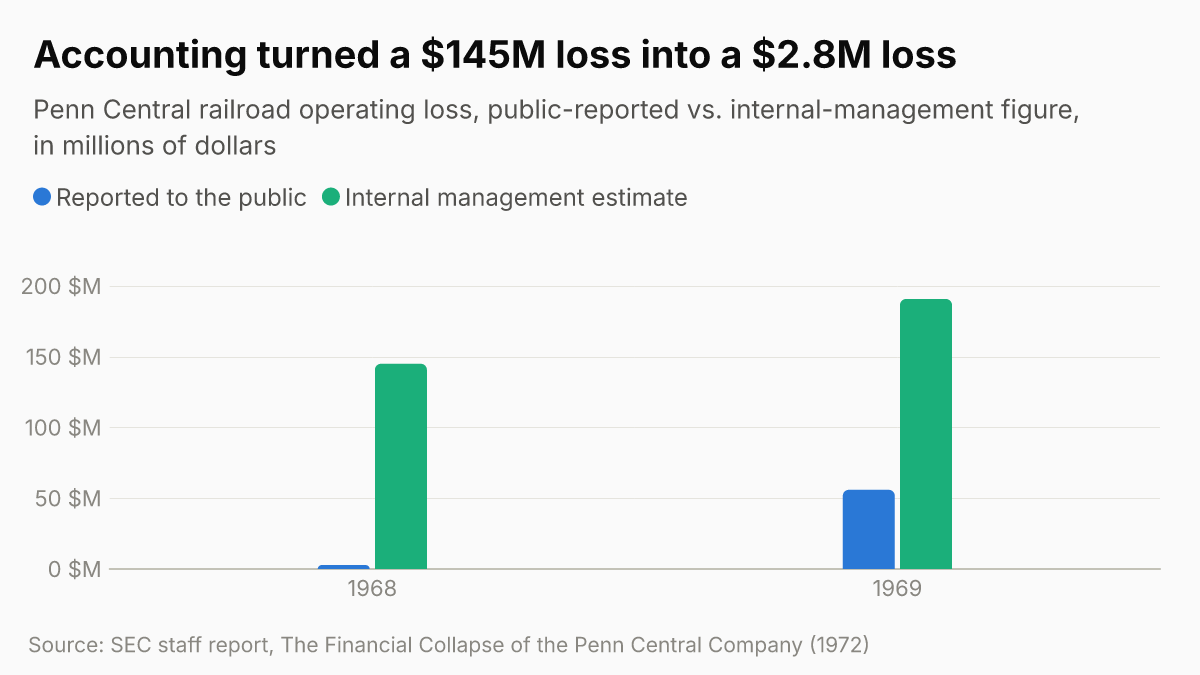
With the railroad melting down, management's answer was to make the numbers look fine. The SEC's staff report found that Saunders pressured finance to record every gain as ordinary and every expense as extraordinary, and that the accounting department "never even got to the meaningful planning stage." In 1968 the railroad actually lost about $145 million but was shown to the public as losing $2.8 million. In 1969 it reported a $56 million loss while the internal figure was $190.8 million; the chief financial officer, David Bevan, put the true number at $220 million. This was technically legal because the ICC, not the SEC, oversaw railroads, and the ICC was lenient about creative accounting.
The cash drain was real and inescapable, about half a billion dollars from merger to bankruptcy. Two decisions made it worse. Penn Central kept paying dividends, about $100 million in the post-merger period at a $56-million-a-year rate through November 1969, financed by borrowing at rising interest. And since 1963 the Pennsylvania Railroad had been diverting cash into real estate and pipelines, a program the House Banking Committee calculated had produced a net cash drain of $175 million, nearly the size of the $200 million federal loan the company would soon beg for. CFO Bevan, "angry and humiliated" at being passed over for the top job, ran a side investment club called Penphil that traded ahead of the railroad on its own deals.
The reckoning came fast. A planned $200 million Defense Production Act bailout and a $750 million follow-on both died in Congress. On June 21, 1970, 871 days after the merger, Penn Central filed for reorganization under Section 77 of the Bankruptcy Act. It was the sixth-largest corporation in America and the largest bankruptcy the country had ever seen. The stock had peaked at $84 in the summer of 1968; the day after filing it traded under $7. Penn Central had over $80 million in commercial paper outstanding, and its default froze the short-term lending market that thousands of companies relied on for payroll. The Federal Reserve had to push more than $2 billion into the banks, and Goldman Sachs, the commercial-paper market leader, came within a hairsbreadth of collapse.
The cleanup took a decade. The SEC filed civil fraud suits in May 1974 against twelve former officers and directors, plus Peat, Marwick and Goldman Sachs. Bevan was indicted in January 1972 on $21 million in diversion charges and, like the executives in so many of these stories, acquitted in 1977 after a long trial. Amtrak took the passenger trains in 1971, and on April 1, 1976, the government folded Penn Central's rail assets into Conrail alongside six other broken roads. The shell that remained kept the real estate and renamed itself American Premier Underwriters. The railroad had been worth saving. The merger of equals that was supposed to create it was what killed it.
The takeaway a modern operator should steal: in a merger of equals, the combination produces nothing. The integration produces everything, and integration is a logistics-and-culture problem, not a deal problem. Penn Central had two networks, two computer systems, and two executive teams who would not share, and it tried to bridge the gap with accounting instead of with an operating plan. That works exactly as long as the cash holds out. The moment you find yourself borrowing to pay a dividend so the stock supports the story, you have stopped running the business and started running the narrative, and the narrative is the most expensive thing you can finance. Pay for the integration first. Everything else is interest on a loan you took out to hide a loss.
That’s the reading for this issue.
- Hearst Cut His Paper to a Penny and Stole Pulitzer's Staff. The Advertiser Was Always the Customer. Jul 28
- A Lawyer Patented the Automobile Before It Existed, Never Built One, and Collected $5 Million. Ford Called the Bluff. Jul 27
- Sears Mailed City Prices to Every Farm. The One-Store Town Died. Jul 26
- An Insurance Company Invented 64,000 Fake Customers. Then It Started Killing Them Off. Jul 25
Want the next one?
Every new Business History Daily issue by email. One tap to unsubscribe.