July 16, 2026
The Match King Paid 20% Dividends on 6% Loans. The $260 Million Gap Was Invented Profit.
Subscribe
Ivar Kreuger traded national match monopolies for loans to cash-starved postwar governments, and by 1929 his securities were the most widely held in the world. The sovereign loans earned single-digit interest. He paid investors double-digit dividends. When the auditor finally opened the books, he found $300 million of reported profit on $40 million of real earnings, and $100 million of forged Italian bonds in the safe.
After the First World War, Europe's governments were broke and rebuilding. Ivar Kreuger, a Swedish engineer who had quietly consolidated his country's match factories into one company, had an offer no one else was making: he would lend them hard currency, and in return they would hand him the monopoly to make and sell matches inside their borders. The first deal went to Poland in 1925, for roughly $6 million. France took $75 million in 1927. In 1929 Germany signed for $125 million at 6 percent interest, granting a match monopoly that the Reichstag voted into law in January 1930 and that would run for fifty-three years, until the final bond installment was repaid in January 1983. (Wikipedia; German match monopoly, Wikipedia)
The structure was a flywheel, of the kind Rockefeller had run through the railroads a generation earlier, and on paper it looked brilliant. Kreuger raised capital from American and Swedish investors through his US vehicle, International Match Corporation, and its banker Lee, Higginson & Co. He lent that capital to governments. The governments gave him a monopoly. The monopoly threw off cash. The cash paid the dividends that attracted the next round of capital. By 1929 he was making two out of every three matches on earth, held monopolies in sixteen countries, ran factories in thirty-six, and his stocks and bonds were, by several accounts, the most widely held securities in the world. (Harvard Business School; TIME)
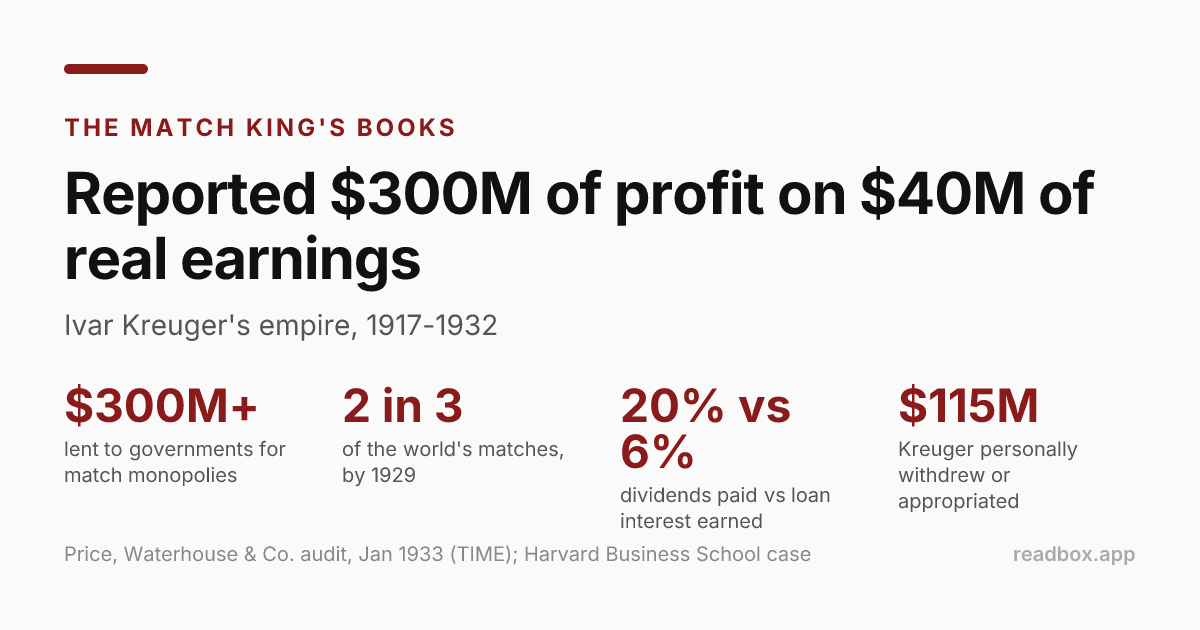
The flywheel had one fatal gear. The sovereign loans paid interest in the single digits, around 6 percent. Kreuger was paying his investors dividends as high as 20 percent. A loan that earns 6 percent cannot fund a 20 percent dividend from its profits; it can only fund it from new capital coming in the door. Every new monopoly was both a real asset and a story to sell the next offering. The morning the new capital stopped, the whole thing was insolvent. The law professor Frank Partnoy argues that, marked to market, Kreuger's empire was already dead the weekend of the October 1929 crash, more than two years before anyone noticed. (UC Berkeley Law)
After the crash, Kreuger kept the wheel spinning by increasingly desperate means. He moved money among more than four hundred subsidiaries, many of them hollow names registered in Liechtenstein, booking fictitious interest between his own companies to manufacture income on the books. When lenders demanded collateral, he had a Stockholm printer run off $100 million of Italian government bonds and signed the names of two Italian finance officials, misspelling one of them several times. (TIME, Jan. 1933; Newsweek)
In March 1932 the Riksbank, Sweden's central bank, told Kreuger it would lend him no more until he produced a full accounting of his companies. He had already borrowed the equivalent of 10 percent of Sweden's GDP from Swedish commercial banks. The meeting with the bank's governor, Ivar Rooth, was set for Berlin on March 13. On March 12, Kreuger was found dead in his Paris apartment with a pistol beside him. (Sveriges Riksbank)
Price, Waterhouse & Co. opened the books and found that over fourteen years Kreuger had reported more than $300 million in profit against perhaps $40 million of genuine operating earnings, a real return of about 1.5 percent on capital. He had taken in $724 million from the public and banks, paid back $180 million in interest and dividends, and personally withdrawn or appropriated assets worth roughly $115 million. The auditor's verdict was withering: the manipulations, it said, were "so childish that anyone with but a rudimentary knowledge of bookkeeping could see the books were falsified." (TIME, Jan. 1933)
There was a real company underneath the fraud. Swedish Match survived, repaid its government loan, and still exists today; the German monopoly paid interest for decades. John Kenneth Galbraith called Kreuger "the Leonardo of larcenists," and the Kreuger crash helped push the US Congress to pass the Securities Act of 1933, the first federal rule that companies selling shares had to tell the truth about their finances. (Wikipedia; Ohio State Univ. accounting study)
The takeaway. Kreuger's machine was not a corner or a plain swindle. It was an arbitrage between two yields that could never close on their own: he borrowed at the cost of capital markets' appetite for growth and lent at the price of a broke government's desperation, then called the spread profit when it was really a queue that needed the next investor's dollar to pay the last one's dividend. The lesson for an operator is to do the arithmetic on any flywheel that pays out more than its assets earn. If the only thing keeping the dividend whole is fresh money arriving, you are not running a business, you are running a relay race, and it ends the day the baton stops passing. Kreuger's one genuine innovation, the off-balance-sheet subsidiaries and structured instruments that let him hide the gap, is exactly why disclosure rules exist now, so the next person who tries it has to show the books the day before, not the day after.
Want the next one?
Every new Business History Daily issue by email. One tap to unsubscribe.