July 17, 2026
RCA Offered $1 Million for FM. He Said No. It Ran Out His Patent Clock and Paid His Widow $1.04 Million.
Subscribe
Edwin Armstrong held the patents on wideband FM, the static-free radio that should have replaced AM. RCA held the AM empire, the NBC network, and enough lawyers to outlast a 17-year patent. It never had to prove Armstrong wrong. It just needed the clock to run out.
On December 26, 1933, Edwin Howard Armstrong received the patents on wideband frequency modulation. Armstrong was already a celebrity in electrical engineering: the regenerative circuit, the superheterodyne receiver, super-regeneration, three of the foundational inventions of radio. He had sold the last of those to RCA for cash and 80,000 shares, making him the company's largest individual shareholder. FM was meant to be his masterwork. Where AM varied a wave's amplitude and caught every spark and thunderstorm along the way, FM varied its frequency across a wide 200-kilohertz channel, twenty times an AM station's bandwidth. The payoff was two things AM could not deliver: near-total silence on static, and high fidelity, 50 to 15,000 cycles against AM's ceiling of 5,000. Armstrong demonstrated it to the profession in 1935, and the leading engineers of the day refused to believe what they were hearing.
The problem was who he demonstrated it to first. Armstrong had a standing deal giving RCA right of first refusal on his patents, and in 1934 he brought FM to RCA's president, David Sarnoff. RCA was the world's largest maker of AM radios and, through NBC, the world's largest AM radio network. Sarnoff let Armstrong run field tests from an RCA transmitter on the 85th floor of the Empire State Building, beaming static-free signal 80 miles, then told him to pack up his equipment. Sarnoff later said he had expected a filter that would clean up AM, not a whole new medium.
I didn't think he'd start up a whole damn new industry to compete with RCA.
That was the whole conflict in one sentence. FM did not just sound better than AM. It threatened to obsolete the AM receivers in every living room, the AM transmitters at every NBC affiliate, and the royalty stream RCA collected on the basic AM radio patents through its cross-licensing pool with GE, Westinghouse, and AT&T. Worse for RCA, Armstrong owned the FM patents outright, outside the pool. Adopting FM meant the incumbent that spent its life collecting patent rents would start paying them to one outside inventor.
Armstrong pushed on without RCA. By the end of 1941 nearly 400,000 FM receivers had been sold, the FCC had authorized commercial FM on 40 channels, and W47NV in Nashville had become the first licensed commercial FM station. In 1940 RCA offered him one million dollars for a non-exclusive, royalty-free license. Armstrong refused, on the grounds that it would undercut the smaller companies already paying him roughly 2 percent royalties. It was a principled stand for the ecosystem he was building. It was also the refusal that the next fourteen years would turn into a catastrophe.
RCA answered with three moves, each aimed at a different constraint. It suppressed demand by refusing to make FM radios and pouring its weight into television instead. It went after Armstrong's installed base through the regulator, pushing the FCC to move FM out of its 42-to-50 megahertz band. The stated reason was sky-wave interference. Armstrong called it a deliberate reset of everything he had built. In June 1945 the FCC moved the band up to 88-to-108 megahertz, obsoleting roughly 400,000 receivers and dozens of transmitters, and FM's momentum did not recover until the late 1950s. And it went after the clock. Once television's audio standard adopted FM, RCA and a string of other makers, Motorola, Philco, Emerson, Admiral, built FM into their sets without paying Armstrong. He sued RCA and NBC for infringement in July 1948, demanding treble damages. RCA answered with what one account called an army of lawyers and six years of procedural delay.
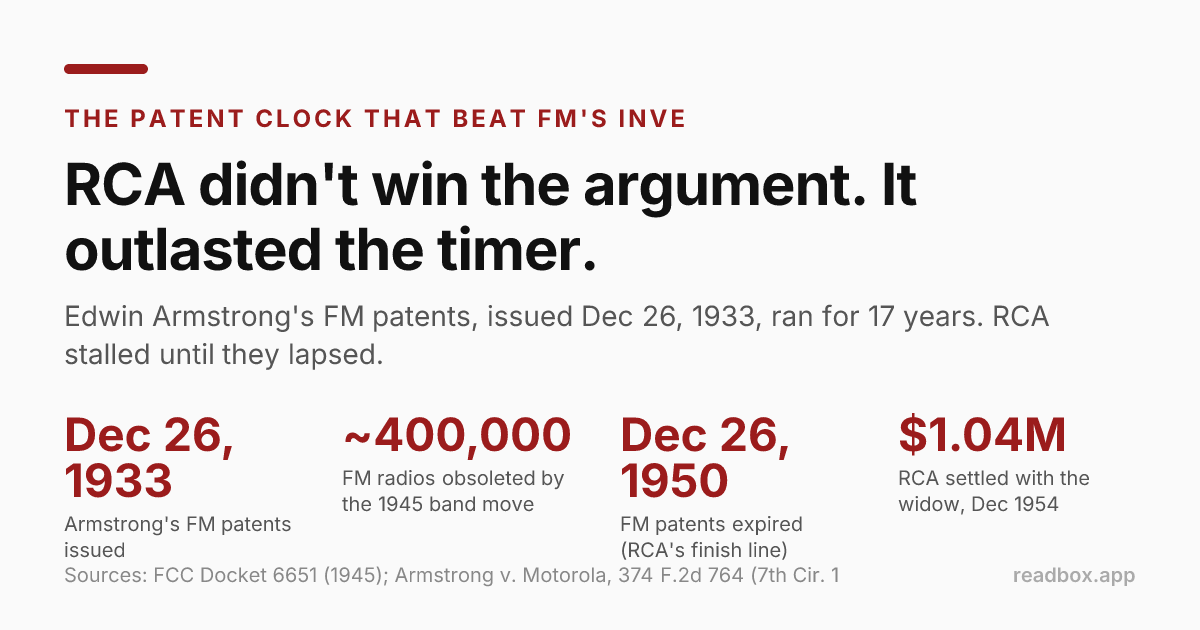
The delay was the strategy, because Armstrong's core patents expired on December 26, 1950. Every month RCA stretched the litigation past that date, the royalties Armstrong could ever recover shrank toward zero, and the cost of fighting ate his savings. RCA told its licensees it would finish the Armstrong case before any of them had to face one of their own. By late 1953 Armstrong had spent almost everything. On November 1 he asked his wife Marion to release retirement funds held in her name so he could keep litigating. She refused and urged him to settle. He picked up a fireplace poker and struck her arm. She left the apartment and never saw him again. Sometime in the night of January 31, 1954, Armstrong wrote her a two-page note and went out the window of their 13th-floor apartment at River House in Manhattan.
The vindication came after him, and it was total. Marion Armstrong and her lawyer Dana Raymond of Cravath, Swaine and Moore won twenty-one of twenty-one infringement suits, every court holding the FM patents valid and Armstrong the inventor. In December 1954 RCA settled for $1,040,000, the same million it had offered the living man in 1940. The last case, against Motorola, closed in 1968. By the late 1970s FM had passed AM in audience share, and by century's end it held three times the listeners. Armstrong had been right about the technology, right about the law, and right about the inventor. He was just outlasted.
The takeaway a modern operator should steal: a patent is a countdown timer, not a moat. Armstrong had the superior technology and, eventually, every court ruling. He lost because the binding constraint was never invention or legal merit. It was channel ownership and time. RCA controlled distribution, controlled the standard-setting process at the FCC, and could afford to litigate past the expiry date that Armstrong could not. The move that actually kills you is not a rival proving you wrong; it is an incumbent that controls the channel resetting your installed base through the regulator while it runs your clock down. If your leverage lives in IP that expires, your only real defenses are to own a channel yourself, make the incumbent need you faster than it can stall, or never let the same company that owes you royalties also sit on the body that can obsolete your standard. (The same incumbent-versus-standard shape as the Edison film trust, with the opposite ending: there the independents escaped the chokepoint; here the chokepoint owner simply waited the inventor out.)
Want the next one?
Every new Business History Daily issue by email. One tap to unsubscribe.